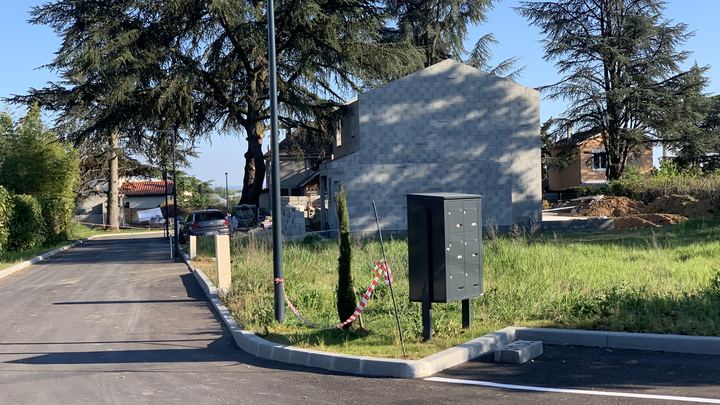
A magnificent plot, provided you go through the neighbour's garden. And ask them nicely.
A beautiful plot, but to get there you have to go through the neighbour's property. Landlocked land puts off buyers and banks. Yet the law provides solutions, and well-prepared landlocked land becomes sellable again.
What is landlocked land?
Land is landlocked when it has no access, or insufficient access, to the public road for its normal use. This is common for plots resulting from old family partitions, at the bottom of a garden or behind other houses.
What the law says: the right of way
Article 682 of the Civil Code allows the owner of landlocked land to claim a right of way over neighbouring land, in return for compensation proportionate to the damage caused. The passage is in principle set on the side where it is shortest and least damaging to the neighbour (article 683).
Three other rules matter when it comes to selling:
If the land became landlocked following a sale or a partition, the passage is first claimed over the plots resulting from that division (article 684). This is the typical case of family partitions.
The location and form of the passage are fixed by thirty years of continuous use (article 685). A path used for decades therefore has value, provided it can be proved.
If the land obtains another access, for example after buying a plot, the neighbour can ask for the right of way to be removed (article 685-1).
Ideally, this passage is formalised in a notarial deed specifying its route, width, use (pedestrians, vehicles, utility networks) and upkeep. A mere verbal agreement or long-standing tolerance weakens the sale. Unless otherwise agreed, upkeep of the path falls to the owner who benefits from it, not to the neighbour whose land it crosses.
A mere verbal agreement weakens the sale.
Why buyers hesitate
- Poorly defined access raises fears of a dispute with the neighbour.
- Without sufficient access, no building permit is possible: landlocked building land is often not buildable in practice.
- Utility networks (water, electricity, sanitation) must also be able to pass.
- The buyer's bank may refuse to finance land whose access is not guaranteed by a deed.
On the planning side, it is the rules of the local plan (PLU) that set the conditions for access and servicing.
A one-metre footpath is not enough for a house. In municipalities without a local plan, the Planning Code (article R. 111-5) allows a permit to be refused if the roads are not suited to the project, in particular if firefighting vehicles cannot get through.
A real-life case (example)
Here is a typical example, anonymised and simplified. A 1,800 m² plot at the bottom of an old family garden, divided between brothers and sisters in the 1970s. It is reached by a 2.50 m driveway on a neighbour's land, without any deed: "we've always gone that way". The land is in a building zone, but the local plan requires wider access for a new home.
Example: buying your access from the neighbour
The solution chosen in this type of case, after boundary marking by a surveyor:
| Plot at the bottom of the old garden | 1,800 m² |
| Current access: driveway on the neighbour's land, no deed | 2.50 m wide |
| Strip bought from the neighbour | 4 m × 35 m |
| Access in full ownership | 140 m² |
The old tolerance disappears, and the plot can be sold as building land, backed by a planning certificate. The price of the strip is negotiable: the neighbour also gains, since there is no longer a passage across their land.
Making the land sellable
- Regularise the right of way by notarial deed, negotiating with the neighbour.
- Buy a strip of land to create access in full ownership.
- Sell to the neighbour, often the first to be interested, or to several neighbours.
- Combine with a neighbouring plot for a joint project.
The steps, in order
- Reread your title deed and old deeds: a right of way may already be recorded there.
- Have a surveyor draw up a plan: possible route, width, length, utility networks.
- Check the access rules in the local plan, or apply for a planning certificate.
- Negotiate with the neighbour or neighbours concerned, before any legal proceedings.
- Sign the deed at the notary's, who registers it with the land registry service.
- Put the land on the market with a complete file: deed, plan, planning rules.
Mistakes to avoid
- Putting the land up for sale relying on the neighbour's tolerance: it can end overnight, with a new owner.
- Leaving utility networks out of the deed: a passage for cars does not necessarily allow pipes to be buried.
- Starting with the court: proceedings take time, cost money and damage a relationship you will need.
Our approach
We examine the land, its access, the planning rules and the neighbours concerned, then present you with the solutions that allow you to sell on good terms.
Frequently asked questions
Can a neighbour be forced to grant a right of way?
Yes, if the land is genuinely landlocked: article 682 of the Civil Code provides for a right of way, in return for compensation. A notarial agreement is preferable to legal proceedings.
Is landlocked land buildable?
Sufficient access is needed to obtain a building permit: without a suitable right of way, the project is often refused.
Who pays for the upkeep of the right-of-way path?
Unless the deed states otherwise, the owner of the land that benefits from the passage, not the neighbour whose land is crossed.
Can a right of way disappear?
Yes: if the land ceases to be landlocked, for example thanks to new access, the right of way can be removed, by agreement or by court decision (article 685-1 of the Civil Code).
Does landlocked land sell for less?
As long as the access is not settled, yes, because the buyer is taking a risk. Once the right of way is signed at the notary's, or the access bought, the land compares with accessible neighbouring plots.
Sounds like your property?
Tell us about it: we look at your case with you, with no commitment.
Get a free opinionRead next